⚡ Fast & Affordable Garage Door Repair · Available Today

Remote gone dead, door reversing before it closes, or a motor that grinds and gives up? We diagnose the actual fault before quoting — and if it only needs a sensor aligned or a gear kit, we'll say so rather than sell you a new unit.
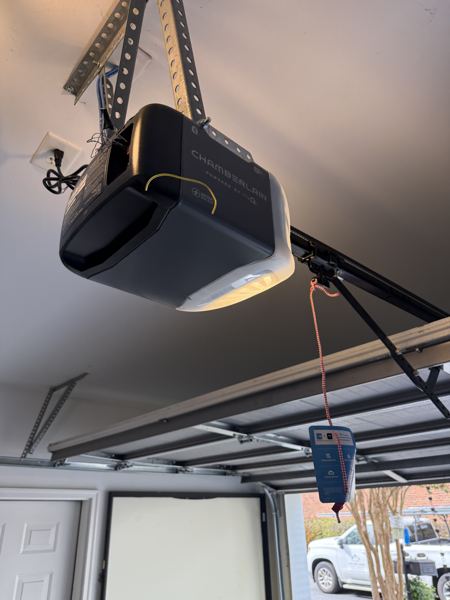
What you're seeing on the left, what's usually behind it on the right. A surprising number of these are cheap fixes.
Plenty of opener problems are worth repairing, and we'll tell you when that's the case. Here's roughly how we weigh it.
The drive is what actually moves the door, and it's the main thing that decides how much noise ends up in the room above the garage.
A reinforced rubber belt instead of a chain. Markedly the quietest option and what we recommend most often, particularly where there's a bedroom over the garage.
Quietest · Most popularA metal chain on a rail. Tough, proven and the most economical, but you'll hear it through the house. Fine for a detached garage.
Toughest · Best valueA threaded steel rod that drives the trolley. Fewer moving parts and little maintenance, with noise sitting between belt and chain.
Low maintenanceMounts on the wall beside the door rather than on the ceiling. Frees up overhead space entirely and is very quiet. Ideal for high or vaulted garage ceilings.
Space savingNot every option is worth paying for. These four are the ones customers tell us they'd never go back on.
Atlanta storms take the power out, and without backup you're pulling the emergency release in the dark to get the car out. Battery backup means the door just works.
Check whether you left it open from anywhere, close it from your phone, and get an alert if it's been open too long. Grant access to a delivery without handing over a code.
The remote code changes every time you use it, so it can't be captured and replayed. Standard on modern openers, absent on much older ones.
The motor eases into motion and slows before stopping instead of jolting. Quieter, and noticeably kinder to the door hardware over the years.
First we check the door moves freely by hand. A heavy door makes a healthy opener look broken.
Sensors, wiring, logic board, gears, travel limits and force settings checked in turn.
If it's fixable we fix it. If replacement is the better call we explain why and price both.
Limits calibrated, sensors aligned, safety reverse tested, remotes and keypad programmed.
Usually not. It's nearly always the photo-eye safety sensors near the floor being knocked out of alignment or dirty. Check both little lights are steady rather than blinking, and that nothing is blocking the beam. If that doesn't do it, call us — it's still one of the quicker repairs.
Typically two to three hours including removing the old unit, mounting the new one, calibrating travel limits and programming remotes and keypads.
Commonly somewhere between ten and fifteen years, depending on how heavily it's used and whether the door itself has been kept balanced. An unbalanced door is the fastest way to wear one out early.
Sometimes, if the new opener is the same brand and uses a compatible frequency. Often it's simpler to program the new remotes supplied with the unit, and we'll set up your car's built-in buttons and any keypad at the same time.
Yes. Openers are rated by horsepower or equivalent force, and matching that to the door's weight matters. Undersizing it is the quickest route to a burnt-out motor. We check the door's weight before recommending anything.
Yes. We service homes on weekends and offer same-day appointments throughout the year. Call to confirm current availability.
Same-day opener repair and installation across Metro Atlanta, with a technician typically at your door within two hours. Book online to save 10%, or call now.
Opener repair and installation across Atlanta, Alpharetta, Buckhead, Cumming, Duluth, Johns Creek, Lawrenceville, Mableton, Roswell, Sandy Springs, Smyrna, Snellville, Suwanee and Tucker.