
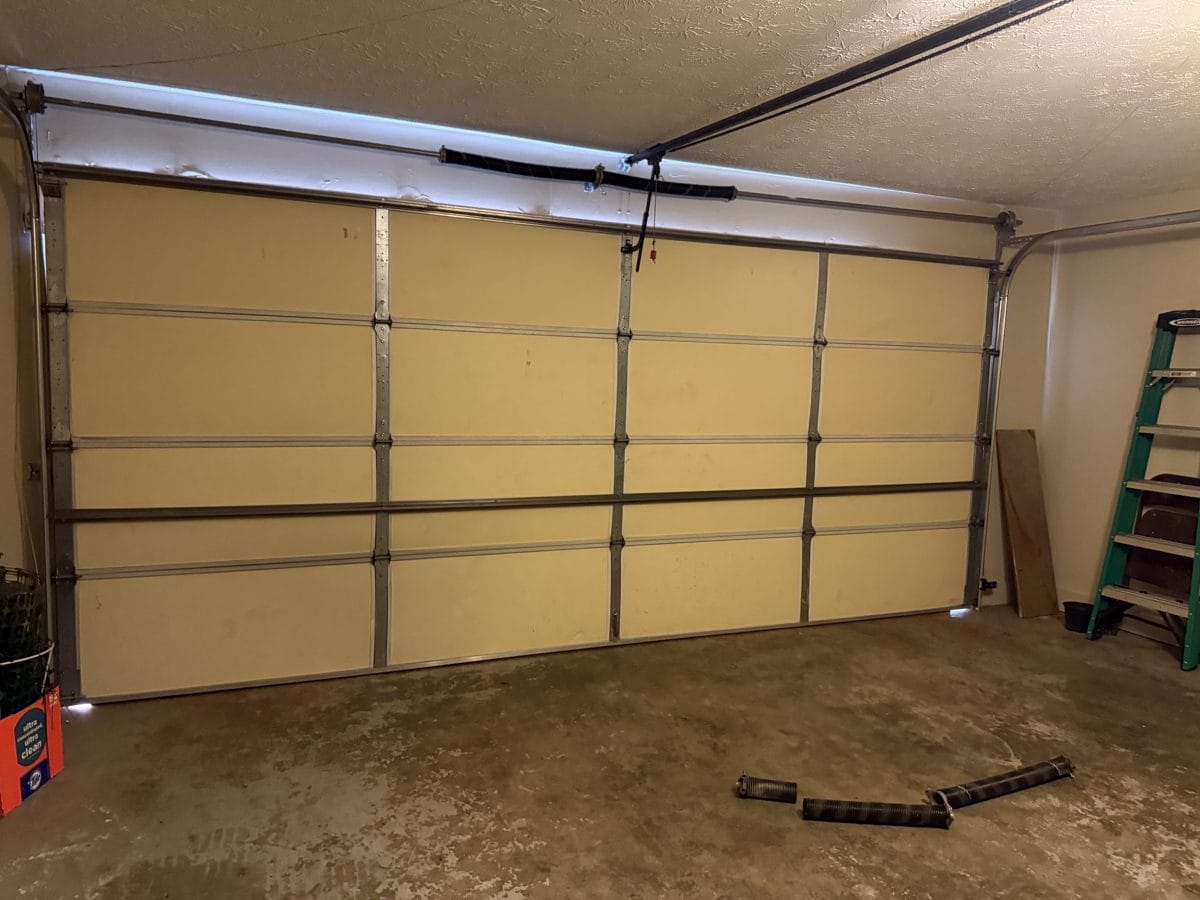
Broken Garage Door Spring? What to Do (and What Not to Do)
You press the button, the opener hums, and the door barely moves, or it doesn’t move at all. Maybe you heard a loud bang from the garage earlier. In most cases, that means a broken garage door spring. It’s one of the most common garage door repairs we handle, and it’s also one of the most dangerous to get wrong. Here’s how to tell if a spring is broken, what to do right now, and what to leave alone.
Signs your garage door spring is broken
Springs do the heavy lifting on a garage door. A typical double door can weigh well over 150 pounds; the springs counterbalance that weight so the opener and you only have to guide it. When a spring breaks, you will usually notice one or more of these:
- A loud bang from the garage, like a firecracker or a dropped board. That is the spring unwinding all at once.
- A visible gap of an inch or two in the coiled spring above the door.
- The door won’t open, or opens only a few inches and stops, while the opener motor runs.
- The door feels extremely heavy when you try to lift it by hand.
- The door closes fast or crooked, or one side hangs lower than the other.
- Loose or tangled cables hanging beside the door.

What to do right now
- Stop using the opener. The opener is not built to lift the full weight of the door. Running it can strip gears, bend the door arm, or pull the opener off its mounting.
- Leave the door where it is. If it is closed, keep it closed. If it is stuck open, keep people, pets and cars out from under it.
- Don’t try to lift the door by hand unless it is an emergency. Without the spring, you are lifting the entire weight of the door, and it can drop without warning.
- Get your car out another way, or wait. If your car is trapped and you need it today, tell the technician when you call so they can plan the visit around it.
- Call a garage door technician. Spring replacement is usually a same-day repair.
Why you shouldn’t replace a garage door spring yourself
There are plenty of DIY videos, but spring replacement is the one garage door repair we always recommend leaving to a professional. Torsion springs are wound under high tension, and the winding bars, set screws and cone have to be handled in the right order. A slip can cause serious hand, arm or head injuries. Choosing the wrong spring is also common: springs are sized to your door’s weight, height and track, and a mismatched spring will wear out the opener, make the door unsafe to operate, or fail again quickly.
Extension springs, the long springs that run along the side tracks on some older doors, carry their own risk. If one snaps without a safety cable running through it, it can fly across the garage.
Torsion vs. extension springs
Torsion springs
Most homes around Atlanta have torsion springs: one or two heavy coiled springs mounted on a bar above the door. They are smoother, last longer, and are safer when they fail because they stay on the bar.
Extension springs
Extension springs stretch along each side of the door and are more common on older or lighter doors. When we replace them, we make sure safety cables are in place, and we can talk to you about converting to a torsion system.
What happens during a spring replacement visit
- The technician inspects the springs, cables, drums, rollers and opener to confirm what broke and why.
- You get the price before any work starts. Nothing begins until you approve it.
- The broken spring is replaced with one matched to your door. On doors with two springs, we usually recommend replacing both, because they wear at the same rate and the second one is often close to failing.
- The door is balanced and tested, the opener force and auto-reverse are checked, and the moving parts are lubricated.
- Most spring repairs are finished in a single visit with parts carried on the truck.
Learn more on our garage door spring replacement page.
How long do garage door springs last?
Standard springs are rated for a set number of open-and-close cycles, often around 10,000. If your family uses the garage as its main entrance and opens the door four or five times a day, that can mean a spring wears out in roughly six to eight years. Higher-cycle springs cost a little more up front but last significantly longer, and they are worth considering if you use your garage door heavily.
Can a broken spring damage anything else?
Yes. Running the opener with a broken spring is the most common way a simple repair turns into a bigger one. It can burn out the opener motor, strip the gear, bend the top door section, or knock the door off its track. If a cable has come loose too, the door can hang crooked and jam. See cable repair and off-track repair if your door has these problems.
Broken spring? We can usually fix it today
Best Choice Garage Doors is based in Peachtree Corners and serves homeowners across Metro Atlanta. We’re available 24 hours Sunday through Thursday and 6 am to 4 pm on Friday, and we’re closed Saturdays. If your spring breaks after hours, see our emergency garage door repair page or call (470) 587-2560.